.jpg&w=1920&q=75)
The Ultimate Guide to Booking NIL and College Athletes for the 2026-2027 Season
College athletes have become some of the most valuable, cost-efficient marketing assets in the country, and the rules governing how brands work with them changed dramatically over the past two years. If you are a corporate marketer, event planner, or brand manager weighing whether to book college athletes for your next campaign, this guide walks you through everything that matters heading into the 2026-2027 season: the new NIL rules, why brands are shifting budgets toward collegiate stars, how to stay compliant, what it costs, and who to consider. By the end, you will know exactly how to move from idea to signed appearance without stepping on a compliance landmine.
Understanding the 2026-2027 NIL Landscape and New Rules
The single biggest shift is that colleges can now pay athletes directly. The House v. NCAA settlement took effect on July 1, 2025, ending the NCAA's long-standing amateurism model and creating a revenue-sharing system on top of the existing Name, Image, and Likeness (NIL) framework. For brands, this matters because it changed both athlete availability and the rules of engagement.
Here are the foundational changes shaping the 2026 NIL guidelines:
- A revenue-sharing "salary cap" now exists. Schools that opted into the settlement can share a capped amount of athletics revenue directly with athletes. That cap was roughly $20.5 million per school in 2025-26 and is estimated at about $21.3 million for the 2026-2027 school year, rising by at least 4% annually across the 10-year agreement. The figure is calculated as 22% of the average shared revenue across the defendant conferences.
- A central clearinghouse reviews outside deals. The College Sports Commission (CSC) now enforces settlement rules, and third-party NIL deals run through NIL Go, an online clearinghouse operated by Deloitte. This is separate from the money a school pays directly.
- Roster limits replaced scholarship limits, reshaping which athletes are on campus and available for outside work.
- Federal legislation is pending, not settled. A bipartisan bill, the Protect College Sports Act of 2026, was introduced in the U.S. Senate but has not become law, so the settlement framework and state laws still govern day to day.
Revenue sharing directly affects a student-athlete's availability for your campaign. Because schools now invest heavily in their own rosters, many athletes have school-affiliated obligations and, in some cases, exclusivity arrangements that limit competing categories. That does not close the door on outside deals, but it does mean you should confirm category conflicts early rather than assume an athlete is a free agent.
Under the current guidelines, college athletes are legally permitted to do a wide range of promotional work, provided each deal has a genuine commercial purpose. Permissible activities include:
- In-person appearances and keynote speaking at corporate events, conferences, and community activations.
- Endorsements and paid social media campaigns, including sponsored posts, product seeding, and content series.
- Autograph signings, meet-and-greets, camps, and clinics.
- Brand ambassadorships and licensing of their personal likeness.
One important restriction: athletes generally cannot use university trademarks, logos, uniforms, or marks in your third-party campaign without a separate license from the school. Your deal covers the athlete's personal NIL, not the institution's intellectual property. Build your creative around the person, not the program's brand assets, unless you have secured school-level permission.
Before you launch, run this quick compliance checklist:
- Confirm the athlete's deal will be reported to NIL Go if the value meets or exceeds $600.
- Document a valid business purpose with real deliverables (appearances, posts, content), not a vague payment.
- Verify you are not using school IP without a license.
- Check state NIL law where the activation happens, since rules still vary by state.
- Confirm no category exclusivity conflicts with the athlete's existing school or collective agreements.
Why Brands Are Choosing College Stars Over Pros (And How to Pick the Right One)
With the framework in place, the strategic question becomes why so many brands are moving budget from professional athletes to collegiate ones. The short answer: college athletes deliver stronger localized engagement, authentic Gen-Z appeal, and far better cost-efficiency per dollar than most established pros.
A regional bank activating in a college town gets more genuine lift from the local university's star quarterback than from a national NFL veteran who has no roots in that market. College athletes are still students, still accessible, and still building their brands, which makes their endorsements feel earned rather than transactional. That authenticity is the differentiator. Audiences, especially younger ones, trust a college athlete's recommendation in a way they no longer trust a polished veteran spokesperson.
To pick the right athlete, evaluate influence and fit rather than name recognition alone:
- Real audience size and engagement rate, not just follower count. A player with 150,000 highly engaged followers can outperform one with a million passive ones.
- Audience-to-market fit. Match a local university hero to a regional activation and a national championship-caliber star to broad, national reach.
- Content quality and posting consistency, which predict how well sponsored content will actually perform.
- Category alignment and reputation, since the athlete's personal brand becomes your brand for the duration of the campaign.
The most effective integrations tend to be the ones where the athlete genuinely belongs in the room: a hometown standout headlining a community keynote, a women's basketball star fronting a campaign aimed at a female-skewing audience, or a rising football name anchoring a tailgate activation. The rise of women's college basketball viewership has made female athletes especially powerful here, often delivering outsized engagement relative to their booking cost.
Current Athletes, Recent Graduates, and Which One You Actually Need
Before you pick a name, decide which category you are shopping in. This is the decision that most often gets skipped, and it drives everything else.
Every compliance requirement described in this guide applies only to current student-athletes. An athlete who has exhausted eligibility carries none of it: no clearinghouse submission, no valid-business-purpose test, no range-of-compensation review, no school IP entanglement, no academic calendar, and no risk that a court or a waiver decision changes their status between signing and your event date.
That matters because the audience recognition often barely differs. A player who finished a decorated career three months ago is just as familiar to your attendees as a current senior, and in most cases is a considerably better booking: they have a flexible schedule, they can commit to a full event day, and many have already begun building a speaking practice.
The tradeoff is currency. If your campaign depends on an athlete being visible on Saturdays this fall, you need a current roster player and you should budget the compliance work that comes with it. If what you actually need is a credible college sports figure who can hold a room, widen the search to recent graduates, and you will get more for the money with far less friction.
A useful way to frame it:
| What you need | Who to book | Compliance load |
|---|---|---|
| In-season social reach, current-roster relevance | Current NIL athlete | Full |
| Community keynote, leadership session, VIP dinner | Recent graduate or retired standout | None |
| Regional activation in a specific college market | Either, weighted to local ties | Depends |
| National brand campaign with usage rights | Current star or established pro | Full if current |
Navigating Contracts, Compliance, and Student Schedules
Once you have chosen an athlete, execution becomes an operational challenge. You are working with a full-time student who is also a competitive athlete, so NCAA compliance for event planners and careful logistics are what separate a smooth campaign from a canceled one.
Follow these compliance protocols to protect the athlete's eligibility:
- Report qualifying deals through NIL Go. Third-party deals of $600 or more must be reported, typically within about five business days, and must reflect real NIL activation.
- Establish a valid business purpose in writing. The deal should pay for defined services (an appearance, a set number of posts, a signing), not simply exist as a payment.
- Keep documentation clean. Note that the CSC raised its range-of-compensation review exemption from $600 to $2,500 for many associated deals, capped around $15,000 in total associated deals per athlete per year, but reporting and the business-purpose test still apply.
- Coordinate with the athlete's representation and school to avoid conflicts before signing.
For the college athlete endorsement contract itself, best practices include:
- A clear scope of deliverables with dates, locations, and deadlines.
- A morality clause protecting your brand if the athlete's conduct creates reputational risk.
- Academic-contingency terms that gracefully reschedule obligations around exams, travel, or team commitments.
- Usage rights and a defined term, so you know exactly how long you can use the content.
- Payment tied to completed deliverables.
Logistics are where good planning pays off. During the active season, athletes are managing practice, travel, film study, and a full class load. Build in flexibility, book around the competitive calendar (football in fall, basketball in winter, baseball and softball in spring), and lean on virtual appearances during high-stress windows like finals or playoffs. A 30-minute virtual keynote or a recorded content session can deliver most of the value without pulling an athlete off campus.
On timing: start early. For a routine appearance, three to six months of lead time is a healthy minimum. To lock in a top star for a spring 2027 corporate event, begin the process closer to six months out, since the best-known athletes book their limited off-days quickly and their availability tightens as their season approaches.
Budgeting and ROI: What to Expect When Booking College Athletes
Cost is usually the first question, so here is a realistic picture. Pricing for an in-person keynote or appearance varies widely based on the athlete's profile, but current market ranges look roughly like this:
| Athlete Tier | Typical Appearance / Keynote Range |
|---|---|
| Regional or mid-tier college athlete | $5,000 - $15,000 |
| Nationally recognized starter or rising star | $15,000 - $40,000 |
| Elite, high-profile college star (top NIL names) | $50,000 - $100,000+ |
Several variables move that number:
- Social media reach and engagement, which often matters more than on-field stats.
- National championship or playoff visibility, which spikes demand and price.
- Time commitment, including travel days, number of deliverables, and exclusivity.
- Season timing, since in-season dates are scarcer and command a premium.
To measure whether the investment paid off, track the metrics that reflect real business impact rather than vanity numbers:
- Social engagement rate and total impressions across the athlete's owned channels.
- Earned and local media impressions generated by the appearance.
- Event attendance lift compared to prior events without a headliner.
- Lead generation and conversions, using unique promo codes or landing pages.
- Brand sentiment lift measured before and after the campaign.
The smartest way to maximize budget is to negotiate multi-deliverable packages. Instead of paying only for an appearance, bundle it with two or three social posts, a piece of content, and usage rights. You capture more value per dollar, and the athlete gets a cleaner, single-purpose deal that is easier to clear through compliance.
Top College Athletes to Consider for Your 2026-2027 Campaigns
Talent moves fast in the current era. Draft decisions, the transfer portal, and eligibility rulings reshape rosters every offseason, so treat the names below as a starting point and confirm current availability before you build a campaign around anyone. Our Top NIL College Athlete Speakers for 2026 list is the version we keep current.
College Football: the deepest category
Football is where the current-roster inventory genuinely is, and three names carry stories that work as well on a stage as they do in a social post.
Dante Moore is the most interesting booking in college football right now. Coming off a season in which he threw for 3,565 yards and 30 touchdowns and led Oregon to the College Football Playoff semifinals, Moore was widely projected as a top-two pick and turned the draft down to return to school. "Everybody was screaming at me for the money reasons, but at the end of the day, I don't play football for money," he said afterward. He is also one of three athletes featured on EA Sports College Football 27. For any audience where the theme is long-term thinking over short-term payoff, that is a keynote that writes itself.
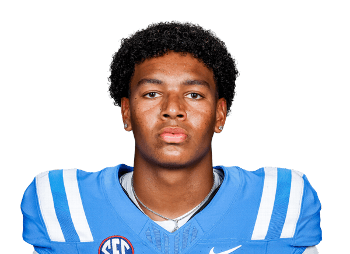
Trinidad Chambliss has the best underdog arc in the sport. He transferred to Ole Miss from Division II Ferris State, entered 2025 as a backup, took over in the second game, and finished the season with 3,937 passing yards, 22 touchdowns, three interceptions, a program-record 13 wins, a Playoff semifinal appearance, and eighth place in Heisman voting. When the NCAA twice denied him a sixth year, he took it to court and won. One caveat worth knowing up front: his 2026 eligibility rests on a preliminary injunction that is still being litigated, so contract with a substitution clause.
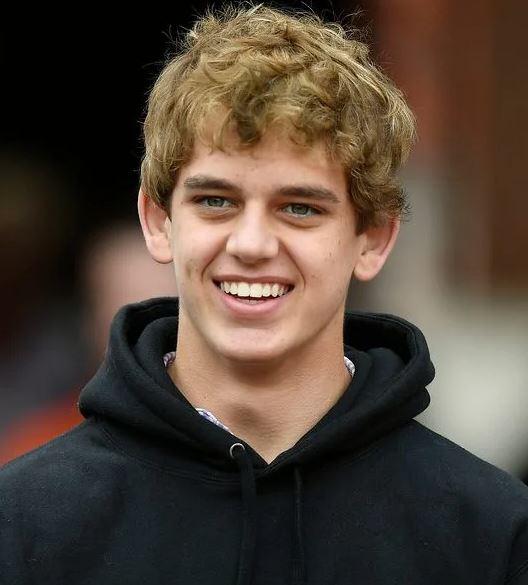
Arch Manning is the highest-recognition name available. He was eligible for the 2026 draft and chose to return to Texas for another year, and he enters the season as a leading candidate to be the first pick in 2027.
Ohio State's Jeremiah Smith and Julian Sayin round out the marquee tier, both with another year of eligibility ahead of them. For depth, and for regional activations where a local name outperforms a national one, the roster also includes Dylan Raiola, Bryce Underwood, DJ Lagway, John Mateer, CJ Carr, Gunner Stockton, LaNorris Sellers, Jalon Daniels, Colin Simmons, Kewan Lacy, and Matayo Uiagalelei, among others on the full football roster.
If your event is a keynote rather than an activation, the stronger play is often a former college star who has already built a speaking career. Tim Tebow, Desmond Howard, Reggie Bush, and Matt Leinart are all Heisman winners with polished stage presence and no compliance overhead. The complete group is on our top college football speakers list.
Women's College Basketball
This is one of the fastest-growing and most engaged audiences in all of sports, and it has the single best comeback story of the coming season. JuJu Watkins was named National Player of the Year as a sophomore, tore her ACL in the 2025 NCAA Tournament, missed the entire 2025-26 season, and is back in full practice with USC. She remains the presumptive top pick whenever she declares for the WNBA draft. Resilience and long-horizon recovery are the obvious themes, and they are authentic rather than assigned.
Practical note: an athlete in her first season back from a 20-month rehab will have tightly protected in-season availability. Plan for an offseason date or a virtual format if your timeline is inflexible.
Paige Bueckers offers the same audience with none of the constraints. She went through an ACL recovery of her own at UConn before winning a national title, and she is now a professional, which removes the compliance layer entirely.
Men's College Basketball
An honest note on this category: the top of men's college basketball churns so quickly, and the best players are so often one-and-done, that a current roster player is rarely a practical booking. By the time your event arrives, they may be in the NBA.
The durable play here is the legends and analysts tier, which is deep. Grant Hill, Christian Laettner, Shane Battier, Tyler Hansbrough, Jay Bilas, Kenny Smith, and Dick Vitale all draw hard on college basketball nostalgia and work especially well for March-timed events and urban-market hospitality. See our college basketball legends list or the broader basketball roster.
Softball
NiJaree Canady is the most decorated name in the sport's recent history and one of the most significant figures of the entire NIL era: she signed softball's first seven-figure NIL agreement when she transferred to Texas Tech, won two NFCA National Pitcher of the Year awards, threw three no-hitters, and holds the record for the most Women's College World Series appearances by any player.
She finished her college eligibility in 2026 and now pitches professionally for the Texas Volts after going second overall in the AUSL draft, with the 2028 Olympics ahead of her. For a booker, that timing is an advantage rather than a drawback: she carries full college-era recognition, she is the definitive voice on what NIL money actually changed, and none of the clearinghouse requirements in this guide apply to her. More on the softball roster.
Gymnastics
Few college sports convert social following into engagement like gymnastics, where top athletes command large, highly interactive audiences that skew toward the lifestyle and beauty demographics brands covet. Suni Lee, Jade Carey, and Grace McCallum are all Olympic medalists who also competed at the collegiate level, at Auburn, Oregon State, and Utah, respectively. Carey won the 2025 AAI Award, gymnastics' closest equivalent to the Heisman, and is a 12-time NCAA All-American.
All three have completed their collegiate eligibility, which makes them straightforward to book. Browse the gymnastics roster.
Wrestling
Wrestling brings intensely loyal, regionally rooted fanbases, and it is a category where booking costs run well below football or basketball for comparable audience passion.
Anthony Robles is the standout. Born without his right leg, he went 36-0 as a senior at Arizona State and won the 2011 NCAA championship at 125 pounds, was named the tournament's Most Outstanding Wrestler, won the ESPY Jimmy V Award for Perseverance, and is now an ESPN wrestling analyst and a National Wrestling Hall of Fame inductee. His memoir was adapted into the 2024 film Unstoppable. He is also a recipient of the NFL Hispanic Heritage Leadership Award, which makes him a strong fit for Hispanic Heritage Month programming.
Cael Sanderson, Dan Gable, Kyle Snyder, Gable Steveson, Kurt Angle, Helen Maroulis, Adeline Gray, and Amit Elor fill out one of the strongest wrestling rosters available anywhere. See the wrestling and freestyle list.
Baseball
Spring sports offer passionate, regionally concentrated fanbases and strong value. Because college baseball's best players turn professional quickly, our depth here sits with former players, managers, and analysts rather than current rosters, which suits keynote and hospitality formats well. Because these seasons run in spring, book by late fall to secure the best names. Browse the baseball roster.
Why Partnering With an Expert Athlete Booking Agency is Essential
Everything covered here, the compliance steps, contract terms, logistics, and shifting rosters, is exactly why most successful brands do not navigate NIL alone. Open NIL marketplaces can look convenient, but they push the compliance risk, negotiation, and logistics onto you. One misstep on reporting or a poorly structured deal can jeopardize an athlete's eligibility and derail your campaign.
A trusted student-athlete booking agency removes that risk. Athlete Speakers offers direct access to top sports celebrities and talent agencies, which means realistic budget alignment, verified availability, and deals structured to clear compliance from the start. That access is especially valuable when you need to secure a high-profile college athlete on short notice for a local campaign, since an established bureau already has the relationships and the process in place.
The value is end-to-end service: initial outreach, contract negotiation, compliance coordination, travel and scheduling logistics, and on-site execution, all handled for you. You get the athlete and the outcome without absorbing the operational burden.
Ready to secure the right college athlete for your 2026-2027 campaign? Browse our Top NIL College Athlete Speakers for 2026, call us at 800-916-6008, or submit a booking request to get direct access to top college stars within your budget.
About the Author
Carson Ingle
Senior Content Writer